

When building a high-end residence in modern Lahore developments like DHA, Gulberg, Bahria Town, or Askari, homeowners spare no expense on premium brickwork, imported tiles, and luxury interiors. However, a critical security element is often overlooked during the final stages: the structural execution of the main entrance. Many assume that buying heavy raw metal is enough to guarantee safety. In reality, raw iron or aluminum is only as strong as the joints holding it together.
Understanding why professional welding matters is the single most important factor when investing in high security home gates. Cheaply made gates put together by amateur roadside fabricators present massive security and safety hazards. To ensure long-term protection, your entrance requires professional gate welding and specialized engineering to withstand both physical forced entry and Lahore’s challenging weather cycles.
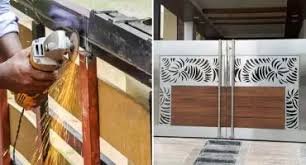
1. The Direct Impact of Welding Quality on Main Gate Structural Integrity
A residential gate is a heavy, moving mechanical wall. If you choose a large, solid wrought iron design, the framework can easily weigh hundreds of kilograms. Managing this weight safely requires absolute structural precision.
The Danger of Spot Welding vs. Continuous Seam Welds
Amateur fabricators often rely on quick “tack” or spot welding to save time and reduce electricity consumption. Spot welding only bonds small points of the metal together, leaving open gaps between the seams. Under the constant stress of opening and closing—or during intense Lahore dust storms—these weak points can crack under the pressure.
True precision gate fabrication relies on continuous seam welding joints. This technique fuses the metal along the entire edge of the connection, creating a single, unbroken piece of structural steel. Continuous welding increases the load-bearing capacity of the joints by more than 300%, ensuring that heavy duty metal doors cannot be easily breached, bent, or forced open by intruders.
2. Preventing Main Gate Sagging and Alignment Failures
One of the most frustrating issues homeowners face within a year of moving in is a sagging gate that scrapes across the driveway or refuses to lock correctly.
Why Structural Sagging Happens
Preventing main gate sagging is a matter of pure physics and math, not luck. Sagging happens due to three main fabrication errors:
- Using improperly rated, thin-gauge metal for the main structural frame.
- Poorly executed corner joints that lack internal triangular reinforcement gussets.
- Installing weak, unrated hinges that cannot handle the weight of the gate.
When a gate sags by even a fraction of an inch, the locking bolts misalign with the wall catch. Once your lock fails to line up smoothly, your home security is instantly compromised. Experienced custom gate manufacturers Lahore calculate the exact center of gravity for each leaf before production. They use heavy, multi-layered frames and build industrial grade heavy duty hinges directly into the gate structure, anchoring them deeply into reinforced iron pillar anchors embedded inside the concrete wall pillars.
3. Climate Defiance: Sealing Out Lahore’s Humidity and Smog
The quality of your fabrication workshop’s welding has a massive effect on how long your gate stays rust-free. Lahore’s high-humidity monsoon season and chemical-laden winter smog are highly destructive to poorly sealed metal.
When an amateur fabricator leaves open gaps in the weld lines, rainwater and morning smog seep deep inside the hollow structural tubes. Because you cannot paint the inside of a hollow pipe, the metal begins to rust from the inside out. By the time you notice rust bubbling under the paint on the outside, the gate’s core structure has already been dangerously weakened.
Professional fabrication workshops guarantee full-perimeter welds that hermetically seal all internal cavities. The entire structure then receives multi layer anti rust coatings, ensuring that atmospheric moisture can never touch raw, unprotected iron surfaces.
Production Quality Matrix: Professional vs. Amateur Fabricators
| Fabrication Feature | Amateur Roadside Vendors | Professional Fabricators (e.g., Al-Noor Metal) |
| Primary Welding Style | Weak spot/tack welding | Continuous, full-penetration seam welding |
| Structural Longevity | High risk of sagging within 12–18 months | Engineered to remain level for decades |
| Internal Rust Protection | None (Open gaps allow water inside tubes) | Completely sealed joints with hidden weep holes |
| Hinge Implementation | Standard thin pipe hinges | Custom machined, grease-fitted ball bearing hinges |
| Locking System Security | Misaligned latches due to structural flex | Precision aligned, heavy-duty anti-pry deadbolts |
4. How to Inspect Gate Welds for Maximum Security
When evaluating a completed gate or auditing a fabricator’s past work, look closely for these signs of high-caliber craftsmanship:
- Smooth, Uniform Beads: A professional weld looks like a clean, unbroken chain of ripples. It should be completely smooth without porous pockets, air holes, or jagged metal edges.
- No Structural Slag: The workspace must grind away all welding slag and splatter before applying paint. A rough, bumpy surface indicates hidden structural flaws beneath the topcoat.
- Perfect 90-Degree Symmetry: Use a square tool to inspect the corner frames. Even a 2mm misalignment across a large 10-foot gate frame will amplify over time, causing track friction and eventual motor burnouts on automated gates.
Frequently Asked Questions (FAQs)
Why does a poorly welded gate ruin automatic gate motors?
If a gate frame is warped or sags due to weak fabrication, it requires significantly more physical force to slide or swing along its track. This constant friction overloads electric gate motors, striping the internal gears and causing electronic circuit failures. Precision-aligned gates glide with the push of a finger, maximizing your motor’s lifespan.
What are the best welding techniques for residential security gates?
For heavy wrought iron and carbon steel gates, MIG (Metal Inert Gas) and Arc welding with deep-penetration rods are preferred for maximum strength. For modern aluminum gates, specialized TIG (Tungsten Inert Gas) welding is required to ensure clean, ultra-strong, and beautiful joints that do not compromise the alloy’s properties.
Can a sagging gate be repaired, or do I need a new one?
Minor sagging caused by failing hinges can sometimes be fixed by cutting off the old hinges and welding heavy-duty ball-bearing replacements back on. However, if the sagging is caused by the gate’s main frame bending due to thin metal or weak corner welds, the entire structure will need to be replaced to restore total security.
How do professional fabricators secure heavy gates to concrete pillars?
Professionals do not simply bolt the hinges directly into masonry bricks. During pillar construction, heavy steel structural plates are welded to the internal rebar cage of the pillar. The gate hinges are then welded directly to these embedded steel anchors, creating an incredibly secure connection that can support tons of weight.
Choose Certified Structural Security for Your Home
A main gate is more than just a decorative boundary—it is the shield that protects your family, vehicles, and property. Skimping on fabrication quality leaves your home vulnerable to structural failures and security breaches.
At Al-Noor Metal, our reputation is built on absolute engineering precision and gate security and durability. Operating from our bespoke metal workshop Township facility, we provide top-tier premium metal fabrication in Lahore. Every single gate we construct features full-penetration continuous welds, reinforced internal joints, heavy-duty structural hinges, and multi-stage industrial rust barriers. We design and build entrances that deliver beautiful curb appeal and uncompromised security for decades.